Start with the process.
Map the trigger, inputs, decisions, and result. Establish what should happen when information is missing, repeated, or incorrect.
When the same information moves between spreadsheets, forms, and apps by hand, useful work gets delayed. We help turn a repeatable process into a system you can understand.
For small teams repeatedly moving information, checking status, producing reports, or coordinating the same handoffs.
Map the trigger, inputs, decisions, and result. Establish what should happen when information is missing, repeated, or incorrect.
Use the APIs and integrations your tools provide. Keep credentials on the server and access limited to what the workflow needs.
Clear status, recoverable failures, and human approval where it matters. A workflow should be understandable after the person who built it hands it over.
Independent products, real interfaces, and inspectable source code. Explore what we’ve built before deciding what we can build for you.
Explore the projects ↗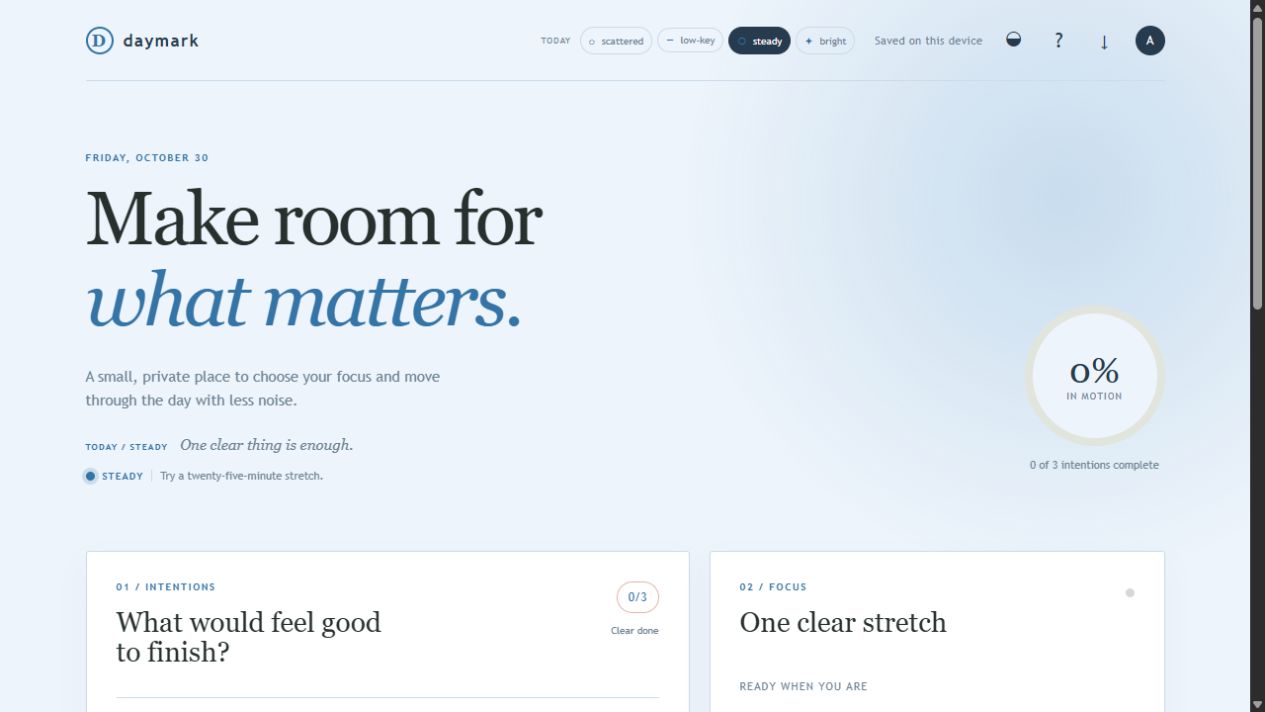 Daymark / From a clear idea to a focused product ↗
Depending on scope: a process map, an integration or automation, error handling, a review step, and operating notes. We check API access, vendor limits, and ongoing costs before agreeing the approach.
Send a short brief through the contact form. We’ll review the fit, clarify the scope, and discuss a proposal. No automated quote or invented timeline.
A frequent, well-defined task with reliable inputs and a measurable outcome. Start with one process you can describe step by step.
No. Rules and direct integrations are often easier to verify. AI is useful when the task benefits from interpreting unstructured information and there is a suitable review process.
For a modest team and a bounded workflow, it can be a useful place to manage records. Access control belongs in the backend; private rows should not be shipped to every visitor’s browser.